Introduction
International tax cooperation has transformed the ability of tax administrations to see across borders. Tax treaties have long enabled tax authorities to exchange information with one another. Provisions based on Article 26 of the OECD Model Tax Convention permit the exchange of information that is foreseeably relevant to administering treaty provisions and domestic tax laws. The Multilateral Convention on Mutual Administrative Assistance in Tax Matters and, more recently, the Common Reporting Standard have taken that cooperation further, moving it beyond case-specific requests towards routine and automatic exchange.
Interestingly enough, the scale of that exchange is now remarkable. In 2024 alone, jurisdictions automatically exchanged information on more than 171 million financial accounts, with a total value of nearly EUR 13 trillion. Cross-border tax administration is therefore no longer defined only by the difficulty of obtaining information, but increasingly by the handling of its growing volume and, more importantly, the meaning of information that now arrives routinely. That is where a different problem begins.
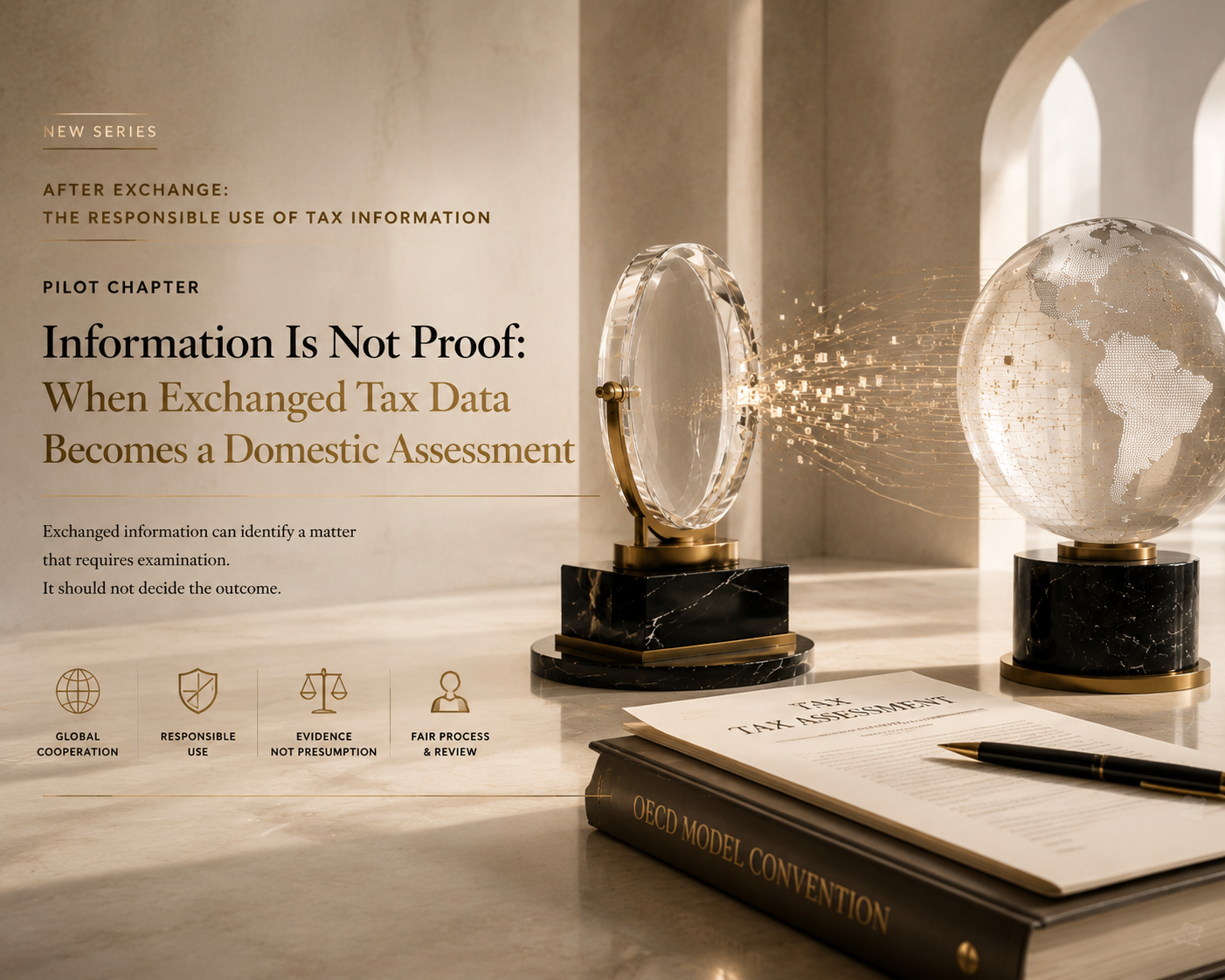
After Exchange: The Responsible Use of Tax Information is a new series devoted to that problem: how tax administrations should understand and use information once it has arrived.
This pilot article focuses on the first and most basic issue: the evidentiary weight that inbound information should carry in a domestic tax assessment.
The issue arises at the point when the receiving tax administration must decide what the information actually establishes. Assume that a CRS report shows that a taxpayer held EUR 1 million in a foreign bank account at the end of the year. The report may justify asking where the money came from and whether the account was disclosed. But the question is: does it also establish that the taxpayer earned EUR 1 million of undisclosed income during that year? The balance may include savings accumulated over time, proceeds from the sale of an asset, or money transferred from another account and already accounted for in earlier tax returns. An account balance is a fact about the account. It is not, without more, proof of the tax conclusion drawn from it. The problem begins when the receiving authority conveniently ignores that distinction.
Information Should Not Become a Presumption
That distinction is not peculiar to CRS data. It appears whenever a tax authority reads a data entry without the context supplied with it. The OECD’s own work reflects this limitation. The Global Forum’s Train the Trainer programme is designed to help tax auditors and investigators use exchange-of-information instruments in their day-to-day work. Its workshop on the effective use of AEOI data covers the matching of incoming information with domestic taxpayers, the treatment of unmatched data and its use in risk analysis. These are described as capacity-building measures, but their existence confirms the basic point: information can be transmitted automatically, but understanding what it means still requires trained judgment.
Courts in several countries have already encountered different versions of this problem. In the United Kingdom, HMRC relied on a loss entered in the wrong box even though the taxpayer had explained elsewhere in the same return why it was there. In Hungary, the tax authority relied on intercepted calls and seized emails obtained through a parallel criminal investigation without the taxpayer’s knowledge. In South Africa, an auditor raised assessments from discrepancies she could not explain and declined the taxpayer’s offer to examine the underlying ledgers. More recently, in India, an assessment was reopened solely on an Insight portal alert, even though the underlying trade data was not supplied, no counterparty was questioned and no independent enquiry was made. These cases concern different kinds of information, but they reveal the same risk: the source or form of the information can displace context, verification and the taxpayer’s opportunity to answer it.
The most dangerous practice, however, is not the initial misreading of information. It arises when an officer issues a notice, receives a full explanation with supporting records, and proceeds as though the response was never filed. Indian courts often describe this as a failure to apply the assessing officer’s own mind, but that phrase understates the harm. The opportunity to respond becomes a formality, while an unsupported addition can be made in a few lines. The taxpayer may then spend years and substantial sums challenging a liability that should never have been imposed. In systems where administrative and judicial review move slowly, the assessment itself can become a means of pressure or harassment. Information is no longer being used to investigate a liability. It is being used to create leverage.
The Proper Role of Information
The answer lies in defining the role that exchanged information is meant to play. A CRS record, third-party report or automated alert can identify a matter that requires examination. It can tell the authority what to ask and which records to seek. Any resulting assessment, however, must rest on what that examination establishes after the taxpayer’s explanation and supporting material have been properly and fully considered. Information may select a case for inquiry. It should not decide the outcome.
The OECD’s standards say a great deal about what may be exchanged, how it must be protected and whether it is used for a purpose permitted by the exchange agreement. They also encourage administrations to use the information effectively.
The missing question is what evidentiary weight that information should carry in a domestic assessment. A CRS record may establish that a financial institution reported an account and a balance. It does not establish, merely because it arrived through an official exchange, that the balance represents undisclosed taxable income. Exchanged information should therefore carry no presumption about the domestic tax consequence of the fact reported. That conclusion must be established separately after examining the full context, including earlier returns, and properly considering the taxpayer’s response.
This is also where a trust-based approach matters. Although a clean compliance history does not prove that the taxpayer’s present position is correct, it should still shape how the authority approaches an apparent mismatch. Where earlier returns and conduct reveal no pattern of concealment, the administration should begin by seeking clarification and testing the explanation, rather than allowing the new information to prejudice the inquiry from the outset.
All being said, I’d agree with the critics that the principle is easier to state than to administer, and it raises further questions. How far must the receiving authority verify a foreign report? What material must be disclosed to the taxpayer before it is relied upon? Can AI identify risk without turning a risk flag into a presumption? What amounts to meaningful human review when the officer may be the source of error or prejudice? And what protection is meaningful when an unsupported assessment may take years to reverse? This pilot does not attempt to resolve each of those questions. It establishes the premise from which the later articles in this series will address them.
But if the most important issue – one that requires urgent attention- is: The exchange ends when information is delivered. Responsibility for its use begins there.
Bibliography
OECD and Global Forum materials
- OECD, Model Tax Convention on Income and on Capital: Condensed Version 2017.
- OECD and Council of Europe, The Multilateral Convention on Mutual Administrative Assistance in Tax Matters.
- OECD, Standard for Automatic Exchange of Financial Account Information in Tax Matters, Second Edition.
- OECD and Global Forum, Peer Review of the Automatic Exchange of Financial Account Information 2025 Update: Executive Summary.
- OECD and Global Forum, Peer Review of the Automatic Exchange of Financial Account Information 2025 Update: AEOI Terms of Reference.
- Global Forum, Train the Trainer Programme.
- Global Forum, E-learning Courses and Virtual Classes, including the workshop on the effective use of AEOI data.
- OECD, Tax Morale II: Building Trust, Improving Transparency and Communication.
Case law
- United Kingdom: Commissioners for Her Majesty’s Revenue and Customs v Tooth, [2021] UKSC 17.
- European Union/Hungary: WebMindLicenses Kft v Nemzeti Adó- és Vámhivatal Kiemelt Adó- és Vám Főigazgatóság, Case C-419/14, EU:C:2015:832.
- South Africa: Commissioner, South African Revenue Service v Pretoria East Motors (Pty) Ltd, (291/12) [2014]ZASCA 91; 2014 (5) SA 231 (SCA).
- India: Deputy Commissioner of Income Tax, CC-1(2), Kolkata v M/s Amluckie Investment Company Ltd, ITA Nos 2541 and 2542/Kol/2025, order dated 18 February 2026.
- India: Commissioner of Income Tax-7 v M/s Odeon Builders Pvt Ltd, Review Petition (C) Diary No 22394 of 2019 in Civil Appeal Nos 9604–9605 of 2018, order dated 21 August 2019; reported at (2019) 418 ITR 315 (SC).